
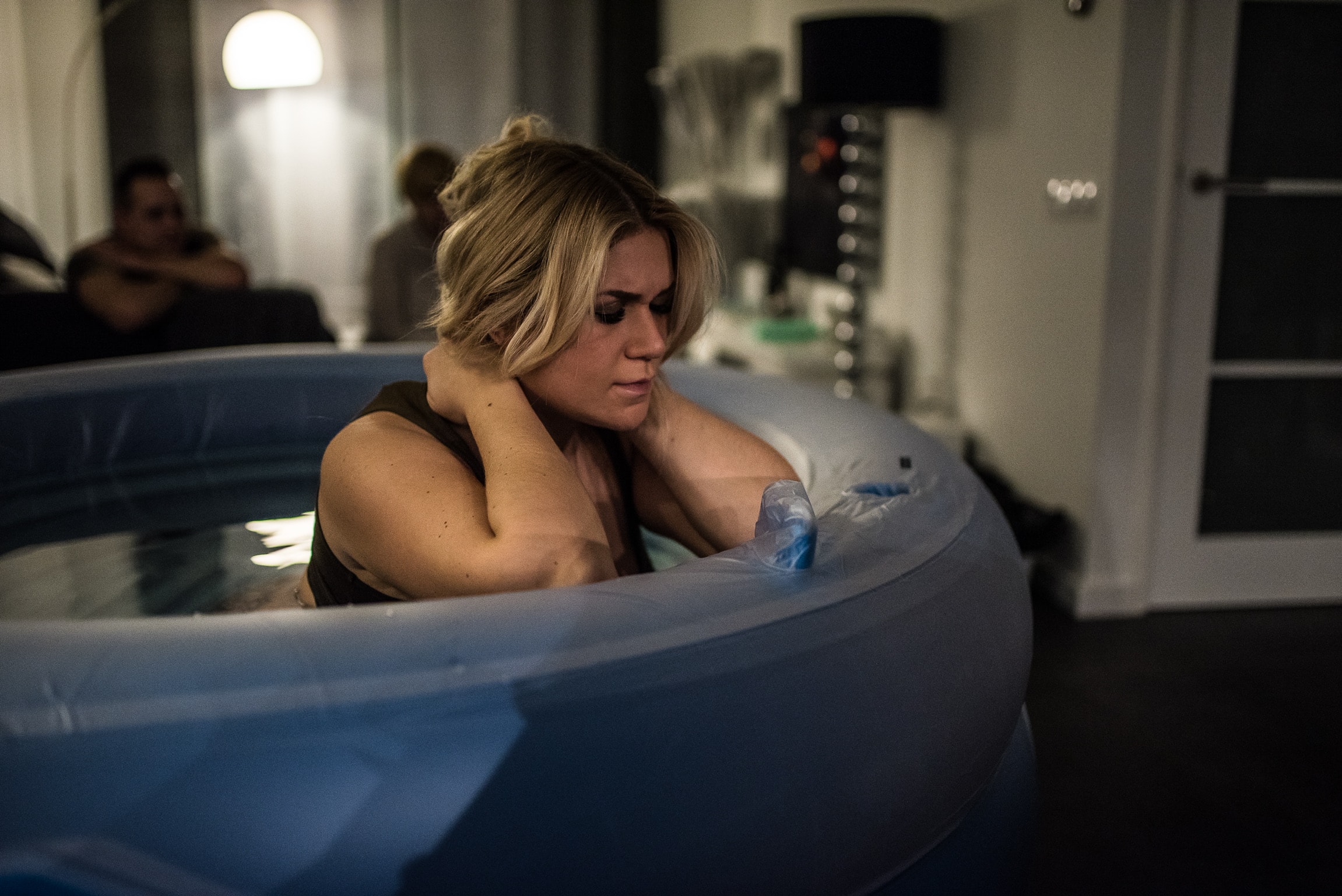
This is the part most women want to know about but find hardest to picture. What does it actually feel like? When do you get in the water? What happens during the intense parts? And what is the moment of birth actually like?
Every birth is different, but there’s a shape to it that’s worth understanding — not so you can follow a script, but so nothing takes you completely by surprise.
The early part
Labour usually starts slowly. Contractions might feel like period pains or a tightening across your abdomen. This can last hours — sometimes a whole day. During this phase, most women stay out of the pool. Walk, eat, rest, breathe. The water is most effective when contractions are strong and regular, so getting in too early can actually slow things down.
Your midwife will help you judge the timing. A common rule of thumb: when you can no longer talk through a contraction, it’s worth thinking about filling the pool.
→ From first signs to getting in — early labour and timing
In the water
The moment you get into the pool is one that almost every woman remembers. The warmth and buoyancy change how contractions feel — not gone, but more manageable. Your body relaxes. You can move freely: kneeling, leaning forward over the edge, floating on your back, squatting. There’s no “right” position — your body will find what works.
Pain relief in water comes from multiple sources: the heat relaxes muscles, the buoyancy takes weight off your joints, and the privacy of being enclosed helps your body produce oxytocin and endorphins. Some women combine water with gas and air (Entonox). Others find the water is enough.
→ Pain relief and positions in water
Transition and pushing
Transition is the most intense part of labour — the shift from dilating to pushing. It’s short, it’s powerful, and it can feel overwhelming. Many women describe it as the point where they briefly thought they couldn’t do it. The water helps. The warmth, the containment, the ability to grip the pool handles and lean into the intensity.
When the urge to push arrives, your body leads. Your midwife guides. In water, many women find that pushing is more instinctive — the buoyancy supports a more upright position, and the warmth helps the perineum stretch gradually.
→ The birth itself — transition, pushing, and the moment of birth
The moment of birth
Your baby is born into the water and brought gently to the surface. The dive reflex keeps the airway closed until the baby’s face meets air — this is the same mechanism that has protected your baby in the womb for nine months. That first breath happens at the surface, usually followed by a cry, and then skin-to-skin in the warm water.
It’s the moment everything has been building toward. And for most women, it’s calmer and more intimate than they imagined.
→ Fear, confidence, and the psychology of your birth environment