
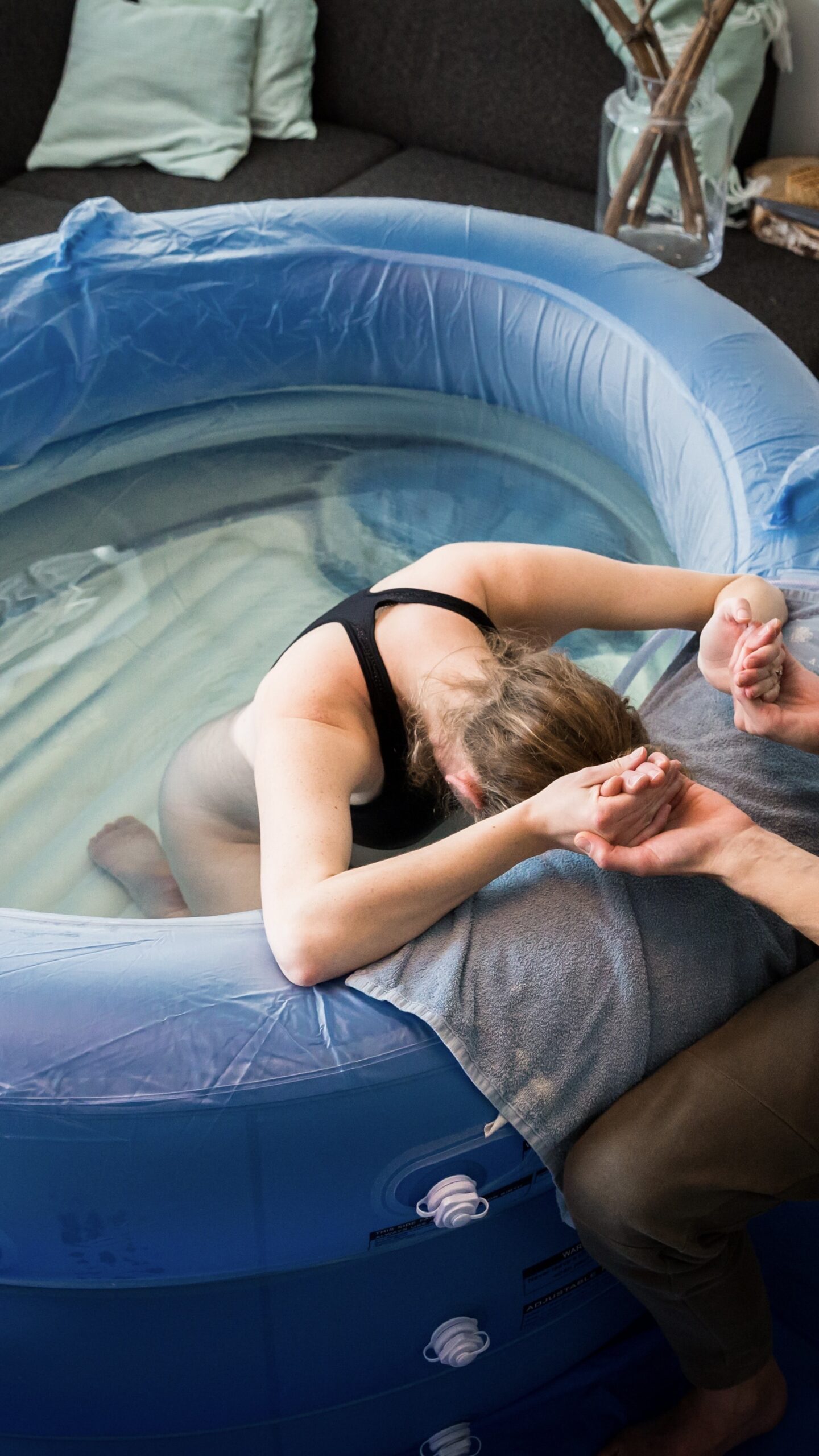
You’ve probably heard the term, maybe seen a photo or a birth story online, and now you’re wondering: is this something I could actually do? That’s exactly where most women start.
Water birth means spending part or all of your labour and birth in warm water — typically a purpose-built birthpool set up in your home. The warmth and buoyancy take the edge off contractions, help your body release its own pain-relieving hormones, and give you the freedom to move into whatever position feels right. Research consistently shows that women who labour in water report less pain and look back on their birth experience more positively.
It’s not new. Midwives have been supporting water births for decades, and in Germany it’s a well-established part of midwifery practice. What is relatively new is the quality of the evidence behind it — and that evidence is reassuring.
Is it safe?
This is the question underneath every other question, so let’s address it directly. The largest studies on water birth show no increase in risk for healthy, low-risk pregnancies when attended by a qualified midwife. The baby doesn’t breathe underwater — a natural reflex keeps the airway closed until the baby’s face meets air. The risks that do exist are well understood and well managed by experienced home birth midwives.
That doesn’t mean water birth is right for everyone. There are clear eligibility criteria, and your midwife will discuss them with you. But for the majority of healthy pregnancies, the evidence supports it.
→ The evidence for water birth
→ Water birth risks — what the evidence actually says
Why women choose it
Pain relief is the reason most women give — but it’s not the only one. Being in water gives you privacy, warmth, and a sense of enclosure that many women describe as deeply calming. You can move freely. There are no cables, no monitors strapped to your belly, no fluorescent lights. Just you, the water, and the people you’ve chosen to have with you.
Many women also say that being at home — in their own space, on their own terms — made a bigger difference than they expected. The pool becomes the centre of that space.
→ Pain relief and positions in water
Common concerns
Every myth about water birth has an answer, and most of them are more reassuring than you’d expect. Will the baby drown? No — the dive reflex prevents it. Is it messy? Less than you’d think — the liner contains everything. Is it only for experienced mothers? No — first-time mothers have water births safely every day.
We’ve written individual articles on each of the most common myths, because you deserve real answers, not dismissive reassurances.