
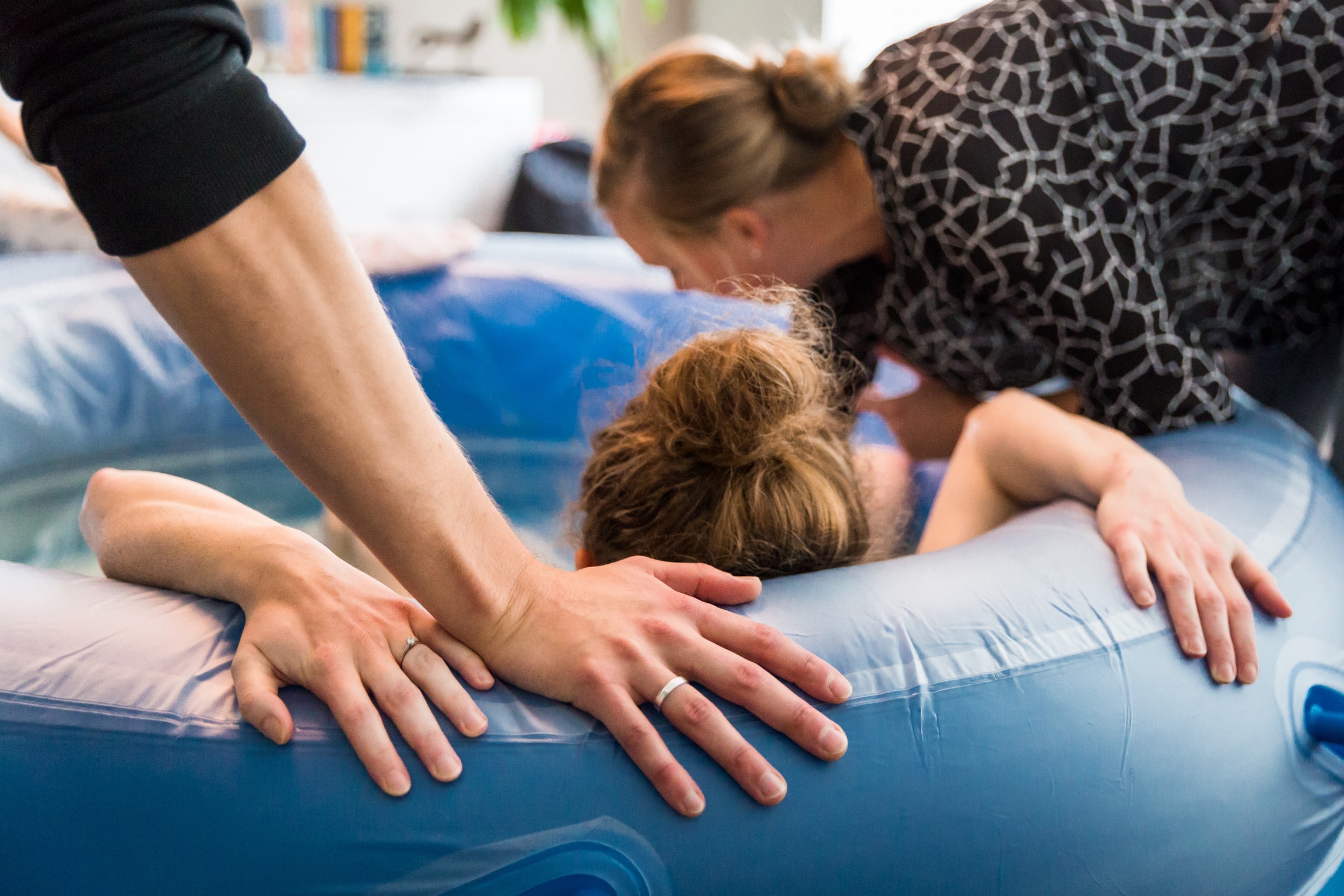
Most women start here: you know you want a water birth, but you’re not sure what the pool actually is or how the whole thing works. Fair enough — it’s not something you encounter every day.
A birthpool is purpose-built for labour and birth. It’s not a paddling pool and it’s not a bathtub. The water is deep enough to cover your abdomen during contractions — that’s the bit that matters for pain relief. There are handles to grip, an inflatable floor for cushioning, and a single-use liner that makes the whole thing hygienic. You set it up when labour starts, use it, and afterwards the liner is disposed of and the pool goes back.
Two sizes: Mini and Regular. The Mini is what most families rent — plenty of room for you, fits in most living rooms. Go for the Regular if you’re over 178cm or want your partner in the water too.
What you actually get
The rental includes: pool, electric pump, hose with tap adapter, liner, and drain pump. That’s everything you need to inflate, fill, use, and empty it.
Higher-tier packages add a thermometer, sieve, floor mat, gloves, a warm cover, and support straps. Nothing needs to be sourced separately.
Will your floor hold it?
Yes. A full Mini pool weighs about 487kg. In over ten years and hundreds of rentals, Trust Birthpools has never had a floor problem. Concrete ground floors are no issue. Older wooden floors — put the pool near a load-bearing wall, not in the centre of the room.
Beyond the floor, you want: proximity to a tap, a warm room, and about 50cm of space around the pool for your midwife. That’s it.
Do a practice run
When the pool arrives, inflate it. Don’t fill it — just pump it up and leave it for a few hours. You’re testing whether the tap adapter fits, whether the hose reaches, and whether there are any punctures from transit. Ten minutes now saves you thirty minutes of problem-solving during labour.
Water
36–37.5°C. That’s body temperature — most women can feel whether it’s right. Keep a thermometer in the pool to be sure. During the pushing stage, stay at or below 37°C — warmer than that risks raising your baby’s temperature.
A Mini fills in 30–45 minutes from a kitchen tap. The Regular takes longer and may need the boiler to recover halfway. Test your hot water supply before the due date: run the tap and time how long until it goes cold.